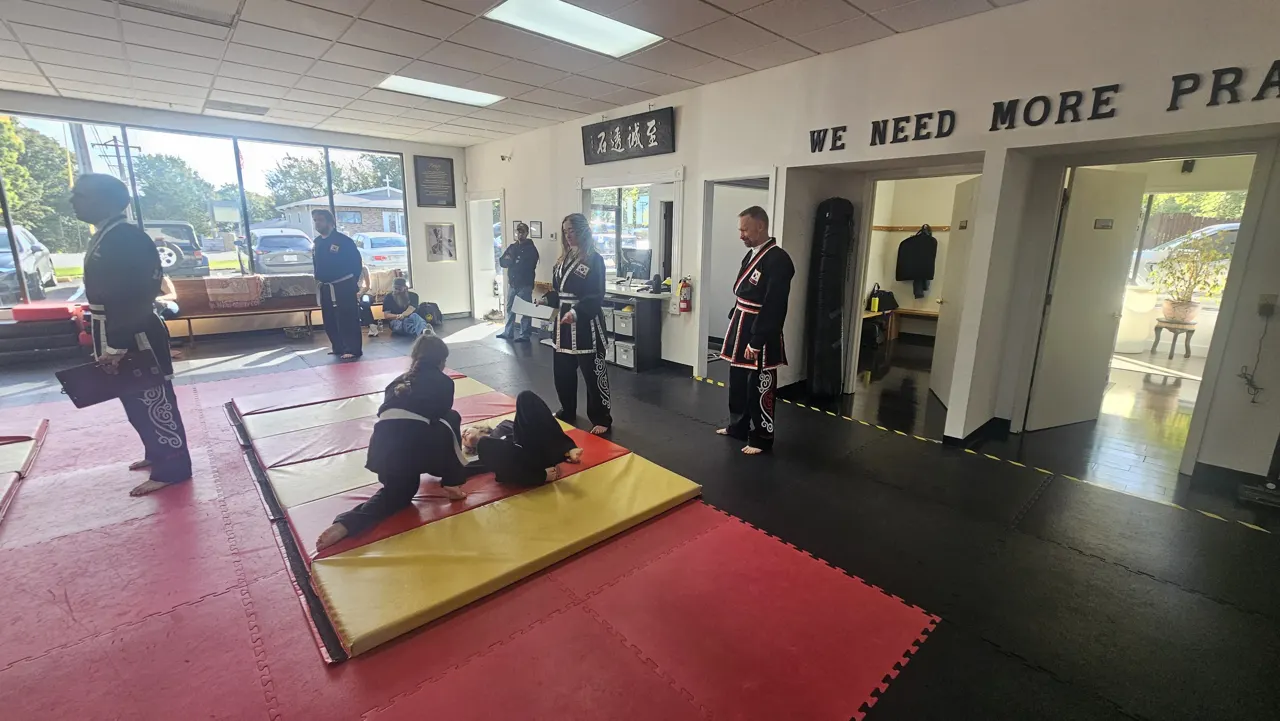
Short answer: at Kuk Sool Won of St. Louis, the very first skill a new student learns is how to fall properly. Learning to align your body as you hit the ground keeps you from getting hurt, so you can get back up and keep going. Kicks and punches come after.
Why falling before fighting?
Falling comes first because you cannot protect yourself with strikes alone. In SBN Jason Fisher's words:
"You've got to protect yourself in other ways, just learning how to kick and punch. You have to protect yourself if you are pushed on the ground, thrown on the ground."
Kuk Sool Won is a big art. Jason calls the curriculum "so large it's overwhelming." That is exactly why the starting point is simple and practical: before anything else, you learn not to get hurt.
What does "falling properly" mean?
Falling properly means knowing how to align your body as you go down so the fall does not injure you. It is a trained habit, not a reflex you are born with. The goal Jason describes is plain:
"When you fall, you don't injure yourself. You can get back up and keep on."
Does falling practice help outside of class?
Yes. Most falls in daily life are not from a fight. They are a slip on ice, a missed step, a trip over a toy. The same body alignment a student practices on the mat is what protects them when they fall anywhere else.
Is it scary for a beginner?
It is one of the first things you do, and it starts at the beginning, for everyone. You do not need to be fit or flexible to start. You can read what the rest of the first three months look like in Your First 90 Days as a White Belt.
Who benefits most from learning to fall?
Kids, first. A child who knows how to fall correctly is safer on a bike, on a playground and on a soccer field for the rest of their life. Parents tend to find this is the part of training they are most grateful for. It matters just as much for adults: a trained fall is a skill you keep, whether you started at seven or at fifty.
Where does falling fit in the Kuk Sool Won curriculum?
Falling is one of the core categories of the art, alongside striking and kicking, throwing, joint locks and traditional weapons. It sits at the very start for a reason: later skills, like being thrown by a partner, only work once you can land safely. Falling and acrobatics keep growing as students move up the ranks, so there is always a next level to it.
Falling at a glance
| When it is taught | First, before kicks and punches |
|---|---|
| What it protects against | Being pushed or thrown to the ground, and everyday falls |
| What you practice | Aligning your body as you land so the fall does not injure you |
| Who learns it | Every new student, child or adult |
| What it builds toward | Throws, acrobatics, and training safely with a partner |
Key takeaways
- The first thing taught at Kuk Sool Won of St. Louis is how to fall properly.
- Falling protects you when kicking and punching cannot: when you are pushed or thrown down.
- It is a skill for life, for kids and adults alike.

Written for families by Kuk Sool Won of St. Louis, an official member school of the World Kuk Sool Association, teaching at 1 Sutters Mill Rd in St. Peters since 1995.